
The five areas of network management defined by the ISO are fault management, configuration management, accounting management, performance management, and security management. Together, these areas form the FCAPS model, a framework used to organize the essential tasks involved in operating and maintaining a network.
FCAPS stands for:
- F: Fault management
- C: Configuration management
- A: Accounting management
- P: Performance management
- S: Security management
Each area addresses a different part of network operations, from detecting equipment failures to protecting systems against unauthorized access. When used together, they help organizations maintain reliable, secure, and efficient networks.
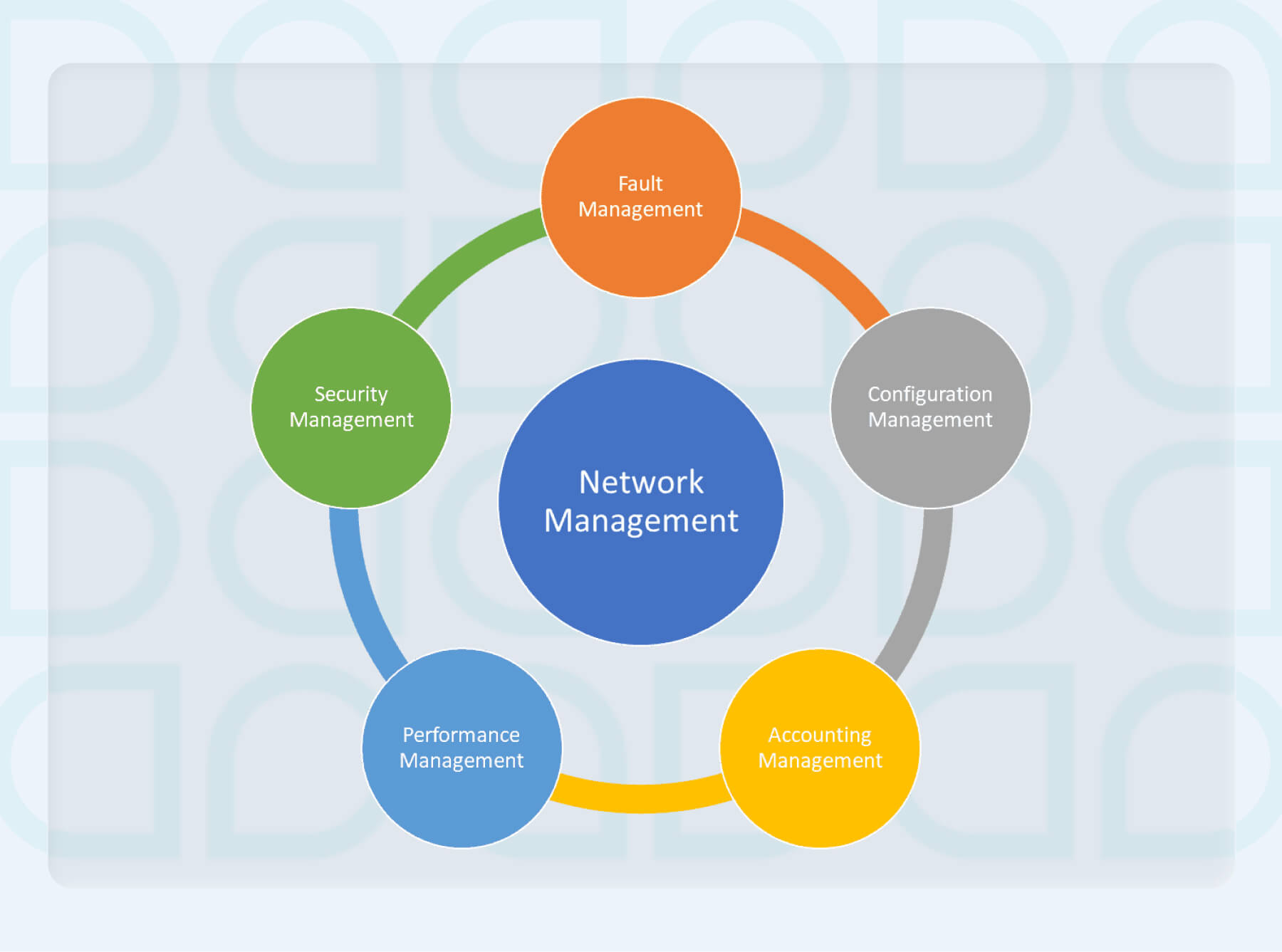
The model is commonly associated with the ISO/OSI network management framework established through ISO/IEC 7498-4. The five functional categories are also explicitly identified in ITU-T Recommendation M.3400 for telecommunications management networks.
What Is the FCAPS Model in Network Management?
The FCAPS model is a structured approach to network management that divides operational responsibilities into five functional areas. Instead of treating network administration as one broad activity, FCAPS separates it into fault, configuration, accounting, performance, and security responsibilities.
This separation helps network administrators:
- Assign clear operational responsibilities
- Standardize monitoring and maintenance processes
- Identify problems more efficiently
- Document network changes
- Track resource usage
- Protect systems and data
- Maintain acceptable levels of availability and performance
The framework can be applied to telecommunications infrastructure, enterprise networks, data centers, cloud environments, and hybrid networks. ITU standards continue to reference FCAPS functions when describing the management of modern telecommunications and software-defined networks.
Although each FCAPS category has a different purpose, the five areas frequently overlap. A configuration mistake, for example, could create a performance problem, trigger a security alert, or cause a complete network fault.
1. Fault Management
What Is Fault Management?
Fault management is the process of detecting, identifying, documenting, isolating, and resolving problems that interfere with normal network operations.
A fault can be any event that prevents a network component or service from operating as expected. Examples include:
- A failed router or switch
- A disconnected network cable
- A malfunctioning wireless access point
- An unavailable server
- An overloaded interface
- A failed internet connection
- A software or firmware error
- A network service that has stopped responding
The primary goal of fault management is to identify problems quickly and restore normal service before the issue causes significant disruption.
Common Fault Management Activities
Fault management typically includes continuous monitoring of network devices, connections, applications, and services. Monitoring systems collect status information and generate alerts when they detect unusual behavior or a service failure.
Common activities include:
- Monitoring device availability
- Receiving and reviewing network alerts
- Recording errors and events
- Isolating affected devices
- Performing root-cause analysis
- Escalating serious incidents
- Repairing or replacing failed equipment
- Confirming that service has been restored
- Documenting the problem and its resolution
Network administrators may use event logs, device notifications, monitoring dashboards, packet captures, and diagnostic tools to determine what caused a fault.
Why Fault Management Matters
Effective fault management reduces the amount of time between the beginning of a problem and its resolution. This measurement is often called mean time to repair or mean time to resolution.
Without an organized fault management process, IT teams may not discover a problem until users begin reporting it. Automated monitoring allows administrators to identify many issues before they develop into widespread outages.
Fault management also helps organizations recognize recurring problems. When incidents are properly documented, administrators can identify patterns and address their underlying causes instead of repeatedly treating the same symptoms.
2. Configuration Management
What Is Configuration Management?
Configuration management is the process of documenting, controlling, and maintaining the settings of network devices, systems, and services.
Every router, switch, firewall, server, access point, and network application has settings that determine how it operates. A single incorrect setting can cause connectivity problems, introduce a vulnerability, or prevent users from accessing an important service.
Configuration management gives administrators a controlled method for making and tracking these changes.
Common Configuration Management Tasks
Configuration management may include:
- Maintaining an inventory of network devices
- Recording hardware and software versions
- Provisioning new network equipment
- Establishing standard device configurations
- Backing up configuration files
- Tracking configuration changes
- Updating firmware and operating systems
- Removing outdated equipment
- Restoring configurations after a failure
- Documenting network addresses and connections
Configuration backups are particularly important. When a router or firewall fails, administrators may be able to restore its approved configuration to a replacement device instead of rebuilding every setting manually.
How Configuration Management Supports Network Stability
Uncontrolled changes are a common source of network problems. A technician may unintentionally change an access rule, assign the wrong IP address, disable an interface, or install an incompatible update.
A formal configuration management process reduces this risk by establishing procedures for requesting, reviewing, testing, approving, and documenting changes.
Standardized configurations also make networks easier to support. When similar devices follow consistent naming, security, logging, and access policies, administrators can troubleshoot them more efficiently.
Configuration records can also help fault management teams. When a problem begins immediately after a configuration change, administrators can review the change history and identify a likely cause.
3. Accounting Management
What Is Accounting Management?
Accounting management tracks how users, devices, departments, applications, or customers consume network resources.
The term “accounting” does not refer exclusively to financial accounting. Within the FCAPS model, it includes collecting and analyzing information about network usage.
This information can show:
- Who is using network resources
- Which services are being used
- How much bandwidth is being consumed
- When the resources are being used
- Which departments or customers create the most demand
- Whether usage limits are being exceeded
For telecommunications providers, this data may support customer billing. For businesses that do not bill users directly, accounting information can support budgeting, internal cost allocation, capacity planning, and resource control.
How Organizations Use Network Accounting Data
Organizations can use accounting data to determine whether network resources are being distributed efficiently.
For example, accounting information may reveal that one application is consuming a disproportionate amount of bandwidth. Administrators can investigate whether the activity is legitimate, limit the application’s usage, or increase available capacity.
Common uses include:
- Customer billing
- Departmental cost allocation
- Bandwidth usage reporting
- Cloud cost management
- License tracking
- Usage quota enforcement
- Capacity planning
- Resource optimization
- Compliance reporting
Accounting management can also support security investigations. An unusual increase in resource consumption may indicate a compromised account, unauthorized application, data transfer, or denial-of-service activity.
Accounting Management in Modern Networks
Accounting management has become increasingly relevant as organizations adopt cloud services, subscription-based applications, and consumption-based infrastructure.
Cloud platforms may charge according to storage, processing, data transfer, or service usage. Without accurate usage data, organizations can struggle to understand where their technology budget is going.
By connecting accounting information with technical monitoring, IT teams can evaluate both the operational and financial effects of network activity.
4. Performance Management
What Is Performance Management?
Performance management is the process of measuring, analyzing, and improving the speed, availability, capacity, and efficiency of a network.
A network may technically be online while still performing poorly. Applications may load slowly, video calls may become unstable, or users may experience delayed access to cloud services.
Performance management helps administrators detect these conditions before they turn into complete failures.
Important Network Performance Metrics
Administrators monitor several measurements to understand network behavior.
Common network performance metrics include:
- Bandwidth utilization: The percentage of available network capacity currently being used
- Latency: The time required for data to travel from one location to another
- Packet loss: The percentage of data packets that fail to reach their destination
- Jitter: Variations in packet delivery times
- Throughput: The amount of data successfully transmitted during a specific period
- Availability: The amount of time a service or device remains operational
- Error rate: The frequency of transmission or interface errors
- Device utilization: The amount of processing power, memory, or storage being used
The significance of each metric depends on the network and the applications it supports. Voice and video communications, for example, may be particularly sensitive to latency, packet loss, and jitter.
How Performance Management Improves Network Performance
Performance management helps administrators establish a baseline for normal network activity. Once the baseline is established, monitoring tools can identify unusual changes or gradual degradation.
Administrators can use this information to:
- Find bandwidth bottlenecks
- Identify overloaded devices
- Improve application response times
- Adjust traffic routing
- Prioritize critical applications
- Plan infrastructure upgrades
- Verify service-level targets
- Predict future capacity needs
Historical performance data is valuable for capacity planning. Rather than waiting for a network to run out of resources, an organization can identify usage trends and upgrade its infrastructure before users are affected.
Performance data can also reveal issues that would not appear in a basic availability check. A device may respond to monitoring requests while still dropping packets, exhausting memory, or operating near its maximum capacity.
5. Security Management
What Is Security Management?
Security management is the process of protecting network systems, services, devices, accounts, and data against unauthorized access, misuse, disruption, alteration, or destruction.
Within the FCAPS framework, security management includes both preventive controls and ongoing monitoring. Organizations must establish security policies, enforce access restrictions, review activity, and respond to suspected threats.
Security management supports the confidentiality, integrity, and availability of network resources.
Common Security Management Responsibilities
Security management can include:
- Managing user identities and permissions
- Enforcing authentication requirements
- Configuring firewalls
- Segmenting network traffic
- Monitoring security events
- Reviewing access logs
- Installing security updates
- Scanning for vulnerabilities
- Encrypting sensitive communications
- Detecting unauthorized devices
- Responding to security incidents
- Reviewing administrator privileges
- Maintaining security policies
Network administrators must also control access to management systems themselves. Monitoring dashboards, device consoles, configuration tools, and administrator accounts can provide extensive control over the network. Access to these resources should therefore be restricted and carefully monitored.
Why Security Is Central to Network Management
A secure network is not created through a single product or configuration. Security requires ongoing management as users, devices, applications, vulnerabilities, and threats change.
Security management is closely connected to the other FCAPS categories.
For example:
- A cyberattack may first appear as a performance problem.
- An unauthorized configuration change may weaken a firewall.
- An unusual increase in usage may indicate data theft.
- A failed security appliance may create a network fault.
- Outdated device software may expose a known vulnerability.
This overlap is why network and security teams need shared visibility into device health, configurations, performance data, usage records, and security events.
How the Five Areas of the FCAPS Model Work Together
The five areas of FCAPS are most effective when treated as connected parts of the same management program.
Consider a situation in which employees report that a cloud application is responding slowly.
A network administrator might use:
- Performance management to confirm increased latency or packet loss.
- Fault management to identify a failing network interface.
- Configuration management to determine whether a recent change affected traffic routing.
- Accounting management to identify an application consuming excessive bandwidth.
- Security management to rule out malicious traffic or an unauthorized data transfer.
The original user complaint may be simple, but determining its cause can require information from all five areas.
Integrating the five categories gives administrators a more complete view of network health. It also prevents teams from analyzing technical problems in isolation.
Benefits of Using the ISO Network Management Framework
The ISO network management framework gives organizations a logical structure for organizing network operations. It does not require a particular software platform or management tool. Instead, it identifies the functional responsibilities that an effective management program should address.
The potential benefits include:
- Clearer operational responsibilities
- Faster fault detection
- More consistent device configurations
- Better infrastructure documentation
- Greater visibility into resource consumption
- Improved network performance
- Stronger security controls
- More accurate capacity planning
- Reduced downtime
- More informed technology investments
The model can also help organizations evaluate their current capabilities. A business may have strong security tools, for example, but limited configuration documentation or no reliable performance baseline. Using FCAPS as an assessment framework can reveal these gaps.
Is the FCAPS Model Still Relevant Today?
The FCAPS model was developed before cloud computing, software-defined networking, remote work, and many of the technologies found in modern IT environments. However, its five functional areas remain applicable.
Cloud and hybrid networks still require organizations to:
- Detect faults
- Control configurations
- Measure usage
- Monitor performance
- Enforce security
The technologies and tools have changed, but the underlying operational responsibilities remain similar. Modern network management platforms often combine several FCAPS functions within a single interface.
For example, one platform may collect device alerts for fault management, back up settings for configuration management, measure bandwidth for accounting, display latency for performance management, and identify suspicious activity for security management.
ITU publications describing newer technologies, including software-defined and quantum key distribution networks, continue to reference FCAPS functionality.
Frequently Asked Questions
What Does FCAPS Stand For?
FCAPS stands for fault, configuration, accounting, performance, and security. These are the five functional areas used to organize network management activities.
Fault management addresses failures and service interruptions. Configuration management controls device settings and changes. Accounting management measures resource usage. Performance management tracks network speed, capacity, and availability. Security management protects systems and data from unauthorized access and other threats.
Which Area Focuses on Network Performance?
Performance management focuses directly on network performance. It measures factors such as bandwidth utilization, throughput, latency, jitter, packet loss, device utilization, and service availability.
The information helps administrators identify bottlenecks, investigate slow applications, evaluate service quality, and determine when infrastructure should be upgraded.
What Is the Difference Between Fault Management and Performance Management?
Fault management focuses primarily on detecting and resolving failures. Examples include an offline router, failed connection, unavailable server, or malfunctioning network interface.
Performance management focuses on how well the network is operating. A device may be online but still suffer from high latency, excessive utilization, or packet loss.
The two areas overlap because declining performance can be an early sign of a developing fault.
Why Is Security Management Important?
Security management protects network resources against unauthorized access, misuse, disruption, and data loss.
It includes identity management, access control, firewall administration, vulnerability management, encryption, security monitoring, and incident response. Without effective security management, attackers may gain access to systems, change configurations, interrupt services, or steal sensitive information.
Who Uses the FCAPS Model?
The FCAPS model can be used by:
- Network administrators
- Systems administrators
- Network operations centers
- Telecommunications providers
- Managed service providers
- Cloud operations teams
- Cybersecurity teams
- Enterprise IT departments
Organizations may not always use the FCAPS name, but most mature network operations programs perform activities that fall within its five categories.
Conclusion
The five areas of network management defined by the ISO framework are fault management, configuration management, accounting management, performance management, and security management.
Together, these functions form the FCAPS model. Fault management keeps services available, configuration management controls network changes, accounting management tracks resource usage, performance management maintains service quality, and security management protects network resources.
By addressing all five areas, organizations can build a more organized approach to management while improving reliability, visibility, security, and overall network performance.